

RIBA Rethink 2025
The Grid

From lined up coffins and temporary hospital beds to socially distanced demonstrations and zoom meetings, a common pattern emerges: An array of people and things equally distanced. Our fluid motion is obsolete, our entropy must be tamed in more rigid formations. Space, once a notion of freedom, has now become a rule; and as all rules comes with a certain stress, that of compliance. In a sense isolation relieves us from it, yet stripping us from our social self which finds expression in zoom parties, virtual classes and band video recordings, again in array. An array of intimate spaces and faces. What if, like a virtual choir, we could coordinate our movement on a physical grid so to restore our social practices? Can this ‘stage marking’ of the public realm help us improvise on a new social choreography?
A grid of 200mm discs, spaced at 2m apart, is manifested in the public realm. It aligns with the prevailing geometry. It adjusts to the constraints of boundaries. Whether a chalk circle or a solar tile, it can be of any design. It can accommodate infrastructure. It can highlight routes and direction. It can host from demonstrations to new radical housing. The grid can simultaneously generate and receive all possibilities, incorporating their multiple forms into its otherwise notional essence. Based on that same idea of space shaping the possibilities of our social being, the grid can inscribe our actions and interactions, our movements, our rests, our long forgotten flows, our habits.
Our world has become 16 times smaller. Floor stickers indicating the wrong thing, a static distance. Upon sight of another human being we pause. Unaware of the routes that liberate our movement we improvise a hesitant dance. The grid can generate a backbone of flows, not yet seen or highlighted in public spaces. In principle, a 4m distance between resting entities allows for free flows to be re-established. In a two way system there are stopping points for crossings. In more restricted layouts passing points are introduced. Regardless of the syntax between moving and static entities there is always a backbone of flow along which we can coordinate our movement. Yet coordination comes with a fundamental skill: awareness of the position of one’s self and the position of others. We have practised this in our virtual relations, we took turns speaking and we listened, we found a pace. Now is the time to master it in the physical world.
The Grid is a tool of paradoxical purpose; it sets out to physically separate us whilst re-enabling our social essence. We participate in this new setting as a chorus, with self-awareness and empathy, with understanding of common objectives. The grid can host life: occurrences and responses, all sorts of revolutions. As all tools of course, is used as needed and as long as it is needed; the Grid can be ignored thereafter or re-activated when necessary, reused or repurposed by generating possibilities under a new post-pandemic scope.

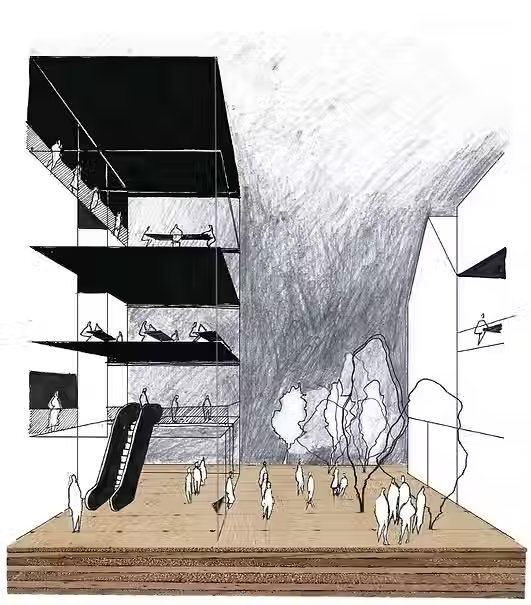


Requisition of the Grid for Climate Change mitigation:
Solar and rainwater harvesting, water infiltration and tree planting