

ABRO development: Designed out - An arboricultural postmortem
- thalia vog
- May 1
- 8 min read

Updated: May 2
There are times when a change to a place happens so abruptly that it forces us to stop and ask: how did we get here? The removal of several mature trees at the former ABRO site in Colchester is one of those painful moments.
These were not just historic trees. They were part of the structure of the place, part of our microclimate and our familiar routes: to school, to town, to work. A green, layered perspective, with a historic footprint, grown over decades. Their value was not theoretical; it was evidential, visible, lived, and shared by humans and animals alike.
As an architect with experience in large developments, I felt compelled to test the assumption that the existing trees were standing in the way of built form yet to exist. Could the proposed layout anchor itself around those trees? Could they be retained without compromising the development? Within a short time, a layout was possible, that retained them without losing housing, gardens, or parking; simply through more careful, principle-driven design.

That matters, because it shows this loss was not inevitable. It was a choice. More concerningly, it reflects an established mindset, that a site is defined only by its boundary, not by what already exists within it. Surface is seen as profit; occupied surface as reduced profit; the ‘existing’ as a de facto obstacle, open for removal. An empty site becomes a prerequisite for design.
In the planning process, lived reality is similarly reduced to something much simpler. Trees become symbols on a drawing, green hatched circles turned red, marks ‘to be removed’ without any real sense of their scale or contribution. What is complex and alive becomes abstract; once that happens, it becomes easier to justify its loss. However, there was a mechanism in place for their protection via Tree Preservation Orders. Half of the trees proposed for removal were protected by the Garrison Tree Preservation Order, whereas three trees without TPO protection were growing outside the allocated site and were therefore public assets. These considerations should have meant something, but as the proposal moved from refusal to appeal to approval, the focus shifted to other complex considerations, superseding that protection. Trees became collateral within a wider process.
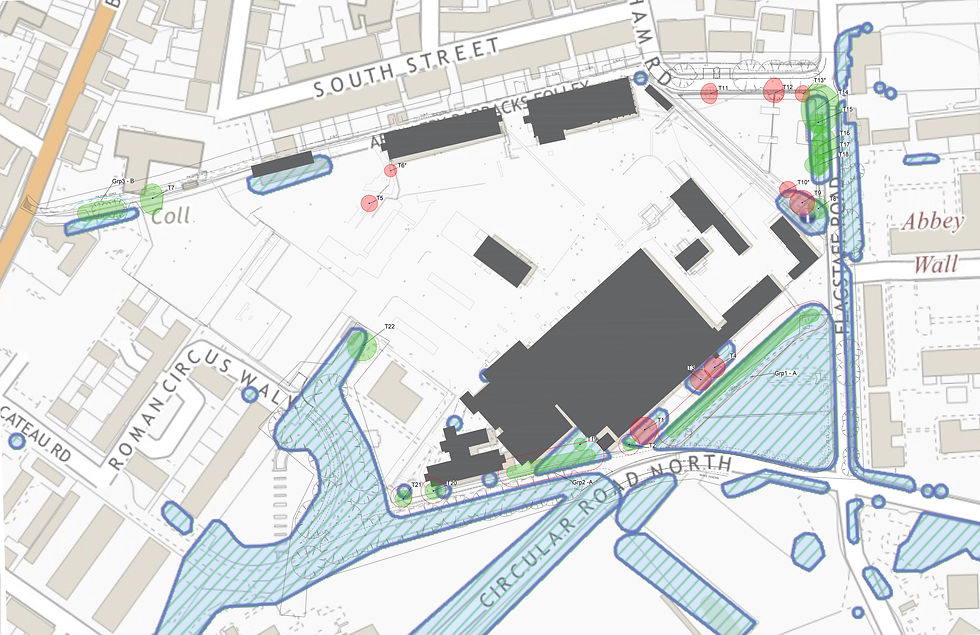
So the question is: at what stage did their protection effectively fall away? And how was the loss of protected features prioritised over other possible concessions?
With my architect’s hat on, I know this can happen very early, at the point where lines are first drawn. The brief comes as a set of fixed development expectations around a certain number of units, a housing mix that reflects profitability and council need, parking spaces, compliant gardens and economical road layouts; everything else has to fit around them. If it does not, it is often nature that gives way: the trees and the landscape. In this case, there is real doubt as to whether those trees were ever intended to become part of the proposed layout. As if design itself dictated their loss. Years-old ecosystems become an afterthought in design, when they should be driving it.
This approach is not limited to trees. Existing buildings are often treated in the same way. The Colchester Civic Society fought successfully to secure listed status for the surviving horse infirmary and ensure its protection on the ABRO development. But there was no equivalent voice for the trees, only a few mentions in residents’ objections; and yet their loss is just as permanent and, for those living around them, excruciatingly painful to watch.
One could argue that the Planning Inspector’s decision to allow the removal of Category B and C trees validates the necessity of their loss. However, the fact that statutory decisions are typically made after the primary layout has already been crystallised does not make the design inherently sound. A Planning Inspector assesses whether a proposal meets a legal threshold, based on the evidence provided, not whether it represents a site-sensitive approach. Notably, in paragraph 28 of the appeal decision (Appeal Ref: APP/A1530/W/25/3363144), the Inspector described the proposed tree loss as ‘regrettable’, a sentiment that underscores the very concern raised here.
The first line of responsibility begins with design. The moment a decision is made to position the plan of a house on top of a tree on paper, the tree’s days are numbered. And the designer, amid other considerations, chose to ignore the trees’ locations, rather than factor them into the design. This is not to dismiss the effort and technical skill invested by the design and planning teams. On a project of this scale, it is clear that many people have worked hard within a dense framework of expectation, policy and regulation. But within that complexity, and competing priorities, important things are lost, whether accidentally, for convenience, or even by principle, in an effort to simplify site constraints.
Statutory mechanisms such as the Biodiversity Net Gain requirement attempt to measure and compensate for environmental impact; yet they risk reducing living environments to a series of calculations, turning natural loss into a form of currency with which to justify it. Within this exchange, few realise that the cost of compensating for mature tree loss can be equivalent to, or even exceed, the cost of arriving at a more site-specific design that would preserve them. The developer paradoxically spends tens of thousands more on compensation for lost trees than they would have spent on the principled design work required to keep them.
And yet, despite these counter-incentives, direct environmental loss is still accepted as the default outcome. Good design should work with what already exists. Sensitive, site-led design should be the primary way we protect the value that is already present. Where design fails to do that, the planning process should be robust enough to question those decisions directly, so that environmental loss is never accepted as the only or easiest option.
Which brings me back to the central question: why is environmental loss treated as unavoidable? Why is it the tree that is removed, and not the parking space or a portion of a garden that is omitted? These are not abstract questions, and their answer lies in the way priorities are set.

Even when not everything can be achieved as the National Planning Policy Framework defines, what do we choose to keep? In this case, with a more considerate design no housing units would need to be lost, just shifted or combined, and there was an opportunity to redesign the ABRO development, as happened, during planning assessment. Why didn’t the council take the opportunity to question the protected trees’ loss, and negotiate their survival? Planning is meant to protect what matters, not just in legislative terms, but for the people who rely on it to safeguard their shared environment. However, protection only works if it holds when it is tested.
Mature trees are not easily replaced. Urban replacement trees rarely reach the scale or ecological richness of those that have been lost. The habitat and microclimate that existed here cannot simply be relocated ten miles away in a biodiversity site. What was here was a legacy, the result of decades of uninterrupted growth and interaction with its surroundings; something that cannot be recreated by the proposed 93 small, urban trees. The submitted biodiversity metric reflects this gap in its own way, identifying a shortfall in biodiversity value despite the doubling of proposed habitats. This only proves the immense ecological contribution of the lost trees [CD3.5 - BIODIVERSITY METRIC_REVB (OCTOBER 2024), available in the public domain, Colchester Planning ref: 231297].
And then there is the timing. Tree felling took place in spring, when canopies are full and birds are nesting, a period when such actions are tightly controlled. One assumes that the necessary checks were followed, but what’s acceptable doesn’t mean it doesn’t carry consequences. The impact is not just visual, or even emotional; it is ecological. It affects life that depends on these trees now, and cannot be meaningfully compensated for decades, the time it takes for habitats of this scale to begin to recover.

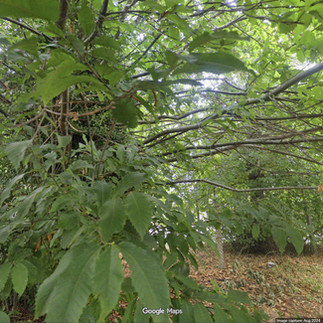

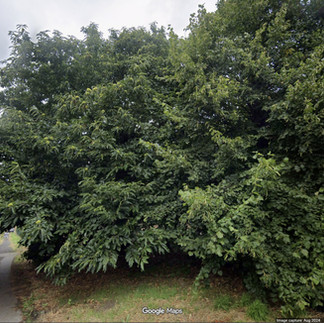

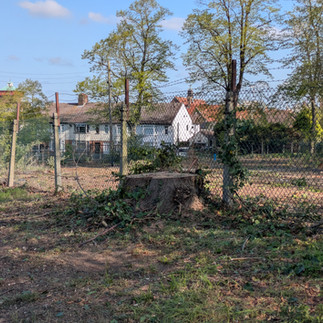
Flagstaff road, two removed trees, before and after. (Source Google Maps and Thalō Concept archive, as indicated)
This is not an argument against the ABRO development, against development in general, or the need for housing. It is an argument for better design, for considerate first lines and sensitive revisions, and for a planning system that genuinely safeguards what matters with logic and sensitivity, beyond the correct paperwork. If ten mature trees could have been saved with just a few hours of considered design work, then this loss was not inevitable; it was the result of a process in which key opportunities were missed.

T1, a 15-metre mature London plane with 40+ years of remaining contribution, was removed not because it was diseased or failing, but to make way for an area of public paving demarcating the roman circus monument beneath [refer to approved layout DSGCCH-SCN-XX-XX-DR-A-01.001-A3 layout, by SCENE and approved Arboricultural Impact Assessment. Colchester Planning ref: 231297]. Why was this loss not questioned? This proposed delineation of the monument didn’t have to be designed as a basic, empty corridor; the tree could have naturally been designed in. If a protected tree of that scale cannot be accommodated within the public realm because of a layer of paving, one has to question how robust are the council’s own designations and planning controls?
Design and planning are powerful tools to manage change. Good design has the ability to resolve controversy. When controversy persists even beyond consent, it is often because design – and the way it has been tested – has failed to manage change effectively, and without unnecessary harm.
Perhaps what is needed is not more policy, but a simple question asked early and honestly by designers and planners: Can we design with preservation in mind, rather than defaulting to justifying impact? This ultimately requires a different starting point, one where existing natural features are treated as the foundation of the design, not constraints to be resolved. Before accepting natural loss as inevitable, it should be challenged at every step, from the drawing board to approval.


Before and After. Walsingham Road, October 2022 & April 2026. (image sources: Google Maps & Thalō Concept archive, respectively)
If a fresh pair of eyes is what is needed, as in this case, let the system provide it early on. It need not be an expensive design panel, but a roaming peer review by local architects who understand the place and its priorities, that can focus on design clashes and suggest alternatives in ways the council’s urban designer is not allowed to. A focused review could test whether the proposed change, and the resulting controversy, might be resolved piece by piece before sacrifices are agreed.
Building is, and has always been, an exchange with nature; we borrow from it to exist in the best possible terms. These terms have transformed from survival to comfort, to provision, to luxury, gain and expansion, using nature's abundance and self-healing resilience to justify its destruction. We create our own new homes by eradicating the old and established homes of other species, choosing to ignore the fact that, despite our human might, we still depend on these very ecosystems to survive. Perhaps, instead of focusing on the fragmented perspectives of what 'development' represents for those involved in the process, we need a moral backdrop to remind us that ‘asset’, ‘value’ and ‘loss’ are not solely of financial essence and that destruction should never be treated as a technical necessity. It is a design choice, and one to be made with genuine care and restraint before we ever accept it as the inevitable price of progress.
The removed trees stood along the periphery of a site large enough to accommodate 203 dwellings, retail space and associated infrastructure - some even outside the red line boundary. There was room to retain them all, with the ABRO development anchored around them. It was simply not the chosen route, and, as a design decision, it deserved greater scrutiny.



Walsingham Road, October 2022 In slideshow order: 1. Foreground: Three removed trees, constituting Living Infrastructure located outside the ABRO site's legal boundary. / background: Two more large trees removed (Source Google Earth, mark-up by Thalō Concept). 2. Location plan extract, not depicting public tree locations. (Source Colchester Planning ref: 231297 Location Plan DSGCCH-SCN-XX-XX-DR-A-00.002-A3, by SCENE ) 3. Overlay by Thalō Concept of location plan and arboricultural drawing, showing the removed trees belonging in the public realm. (Source Colchester Planning ref: 231297 HWA10787_TRRP by HALLWOOD ASSOCIATES)


Comments